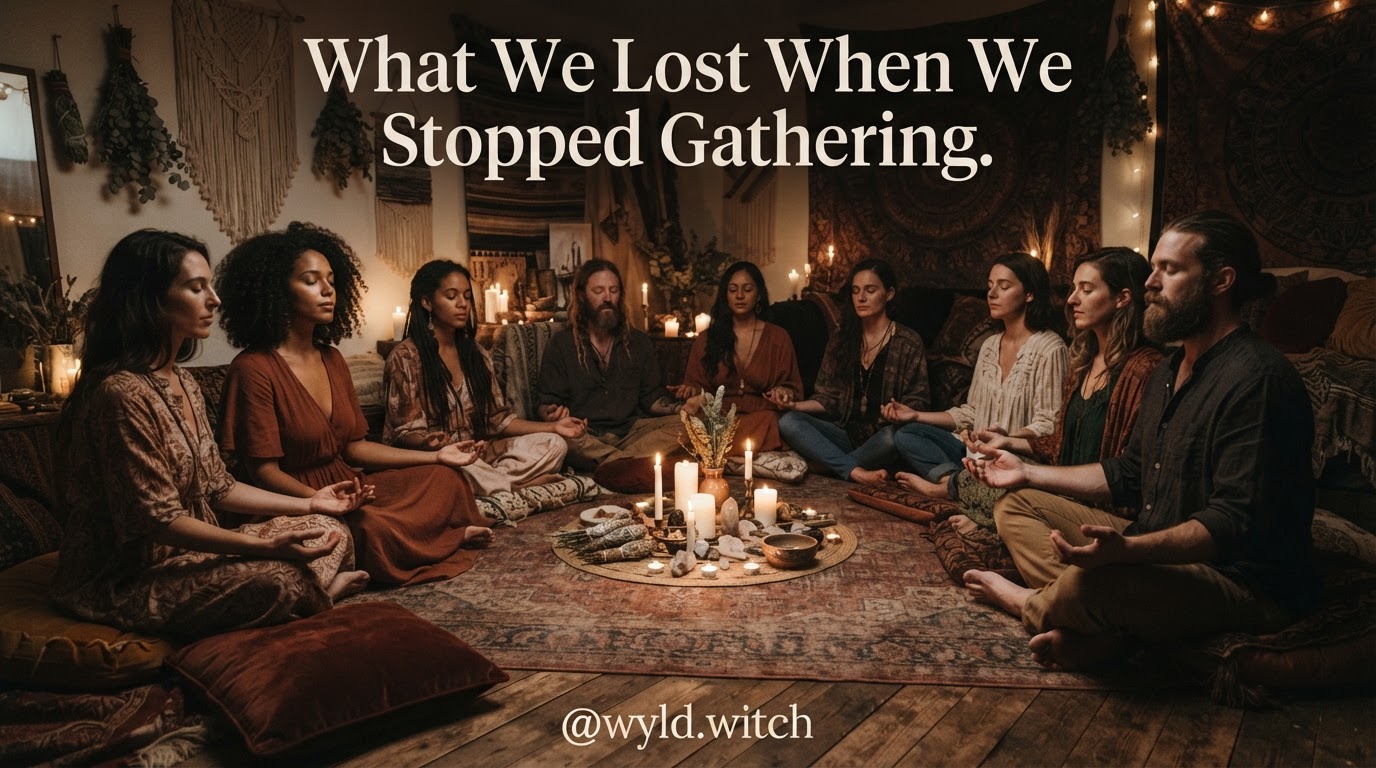

There’s a reason group ceremony is having a moment right now. Sound baths, drum circles, women’s circles, grief rituals held in a room full of near-strangers — it’s showing up everywhere, and it’s not a coincidence.
How We Got Here?
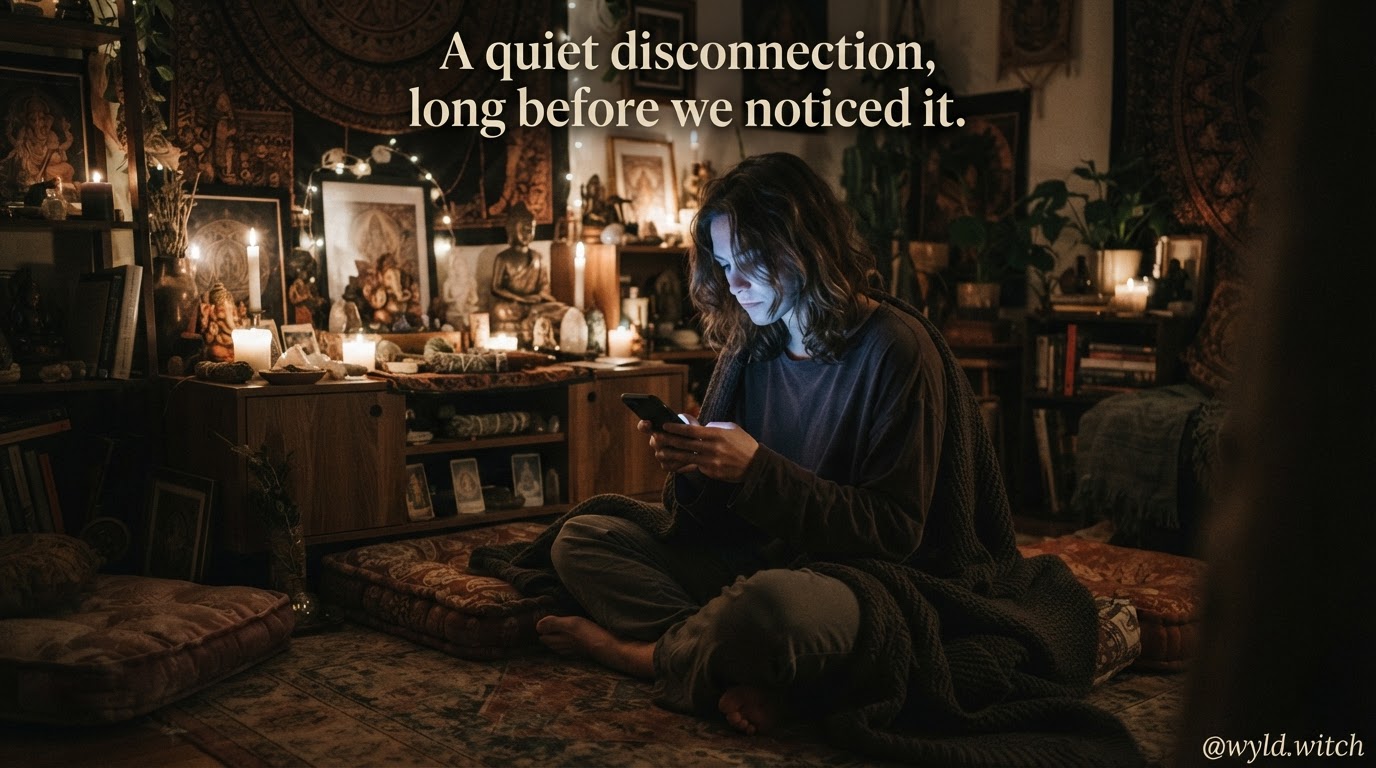
It’s tempting to point to COVID as the moment everything changed — the year we all got shut in our houses and lost our sense of physical togetherness. And it’s true, COVID exacerbated this in a way nothing else could have. But the isolation didn’t start there. It had been building quietly for years before, as social media slowly replaced rooms full of people with feeds full of people.
We were already trading real gathering for something that looked like it from a distance long before lockdowns made that trade unavoidable. COVID didn’t create the wound. It ripped the bandage off one that had been forming for a long time, and made it impossible to ignore.
And here’s the part that’s kept the wound open ever since: when the world reopened, a lot of that gathering never fully came back into the room. It moved to Zoom. It stayed on social media. We kept “seeing” each other through screens because it was easier, more convenient, less scary — and it kept the isolation quietly deepening even as everything else went back to normal.
Scrolling together isn’t the same as breathing together in a room. It never was. And people are done with the substitute. Most of them don’t have a name yet for what’s missing — they just know something is. That’s what ceremony is naming for them.
What We’re Actually Craving
It isn’t the technique. It’s not really about the singing bowl or the specific breathwork pattern or which herbs are burning in the corner.
What people are craving is emotional synchronization — being witnessed while you grieve, celebrate, or release something, without having to explain it in words first. There’s a particular kind of relief in sitting in a room where everyone’s nervous system is moving together, where you don’t have to perform your feelings or justify them before someone else understands. You just get to feel them, alongside other people who are doing the same thing.
That’s the part of self-care we’ve been missing. Relationships and connection have always been part of real self-care — that was never the disagreement. What’s been missing is the face-to-face piece, the in-the-same-room piece, the vibration-to-vibration connection that a screen simply can’t carry. In-person gathering is what gives us that back.
Ceremony is something more than that, though — it’s not just the gathering itself, it’s a layer laid on top of it. Where a gathering of friends restores connection, ceremony amplifies it. It takes that same room full of people and intentionally strengthens the vibration of it, so what you’re feeling together is stronger and more powerful than an ordinary get-together. That’s the difference: gathering brings us back into the room together. Ceremony is what makes what happens in that room mean something more.
Rites of Passage, Old and New
What people are craving today isn’t identical for everyone, but the underlying human need behind it is old, and it shows up across nearly every culture in history — marking the movement between life stages through deliberate rites of passage.
Before we go further, one correction worth making: the maiden, mother, and crone framework — the idea of a single goddess moving through three sequential life stages — is often talked about as ancient wisdom, but it isn’t. It was popularized in 1948 by the poet Robert Graves in his book The White Goddess, and it’s really a twentieth-century Neopagan synthesis rather than something practiced by ancient cultures in that exact form. Scholars researching genuinely ancient triple goddesses, like the three Brigids in Celtic tradition, have found they were typically depicted as age-equals and sisters, not sequential stages of one woman’s life (source). It’s really important to understand that distinction when we’re talking about these ancient traditions — to know what truly is ancient, and what is a modern overlay laid on top of an ancient practice.
What actually is old, across cultures, is the rite of passage itself: a marked, witnessed threshold moment that says you were one thing, and now you are becoming another. Cultures around the world built these for both women and men, though the specific forms varied enormously — there wasn’t one universal template, and it wasn’t split cleanly along the lines we sometimes assume today.
For women, many of those rites were tied to real biological thresholds. First blood, marking entry into womanhood. Menopause, marking a shift into eldership — sometimes described as entering the grandmother’s lodge. And in between those thresholds, ongoing circle work: women gathering to share, witness, and hold space for each other through the long middle stretch of life, where most of us are just trying to be witnessed while we carry everything we carry.
For men, rites of passage have also existed across cultures historically, but many of those structures have quietly disappeared from modern life, without anything clear stepping in to replace them. Without a biological marker like menstruation or menopause to naturally trigger a threshold moment, it has to be built deliberately — and for a long time, that building just wasn’t happening.
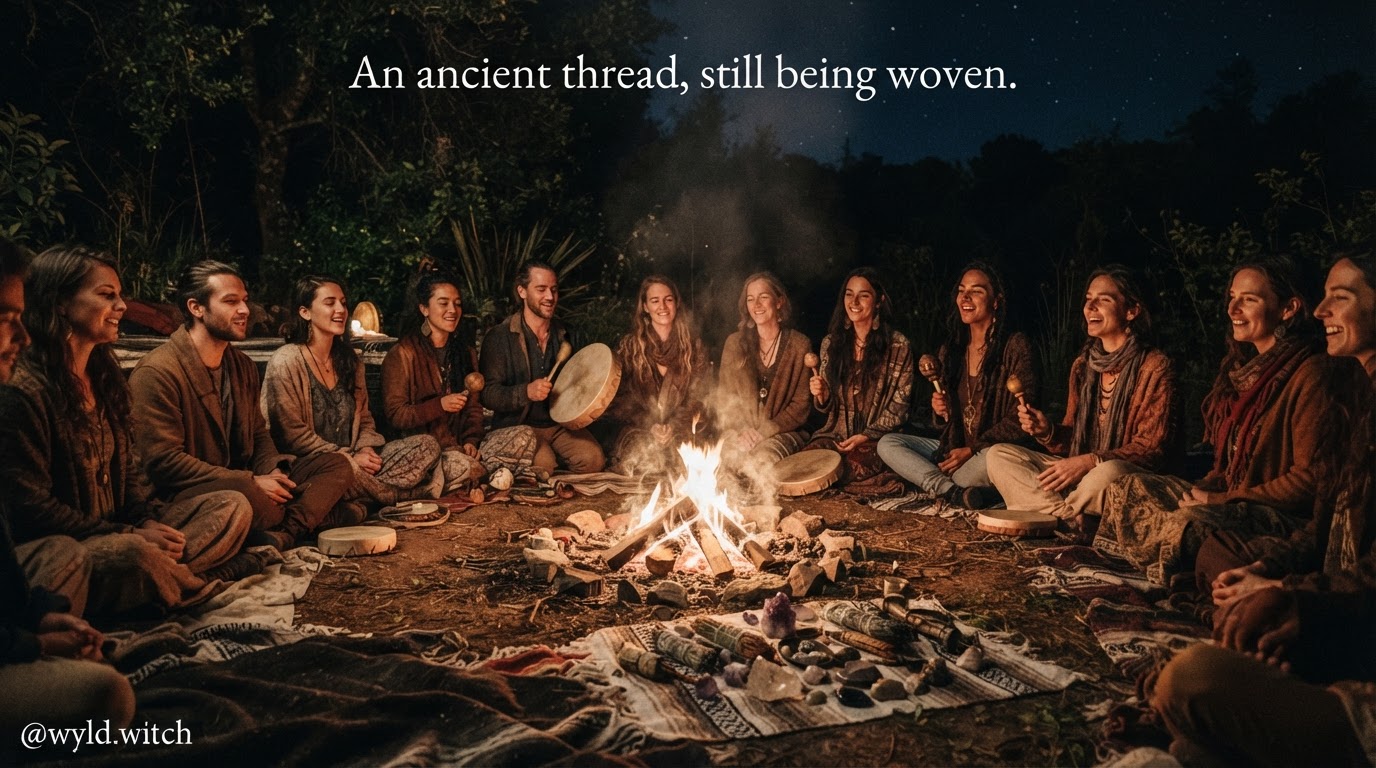
What’s showing up now for men isn’t circle work in the way women practice it. It’s nature immersion, solitude, and challenge — a boyhood-to-manhood threshold that has to be earned and marked, not just aged into. There’s also a second wave showing up in midlife: rites tied to fatherhood, legacy, and reinvention in the forties and beyond. It tends to look like fire, drumming, and brotherhood more than open sharing circles — a different container built for a different kind of vulnerability.
Neither path is lesser. They’re just rites of passage, built in different forms for what each of us actually needs. And as we can see with both men and women, the important shifts in life have always been marked in community, in a space where we can be witnessed, celebrated, and receive support from everyone around us. In that community, witnessing and holding space for one another is what we call ceremony. We have been so disconnected from it for such a long time, and so damaged by that disconnection, that this truly becomes the solution that can make us whole again.
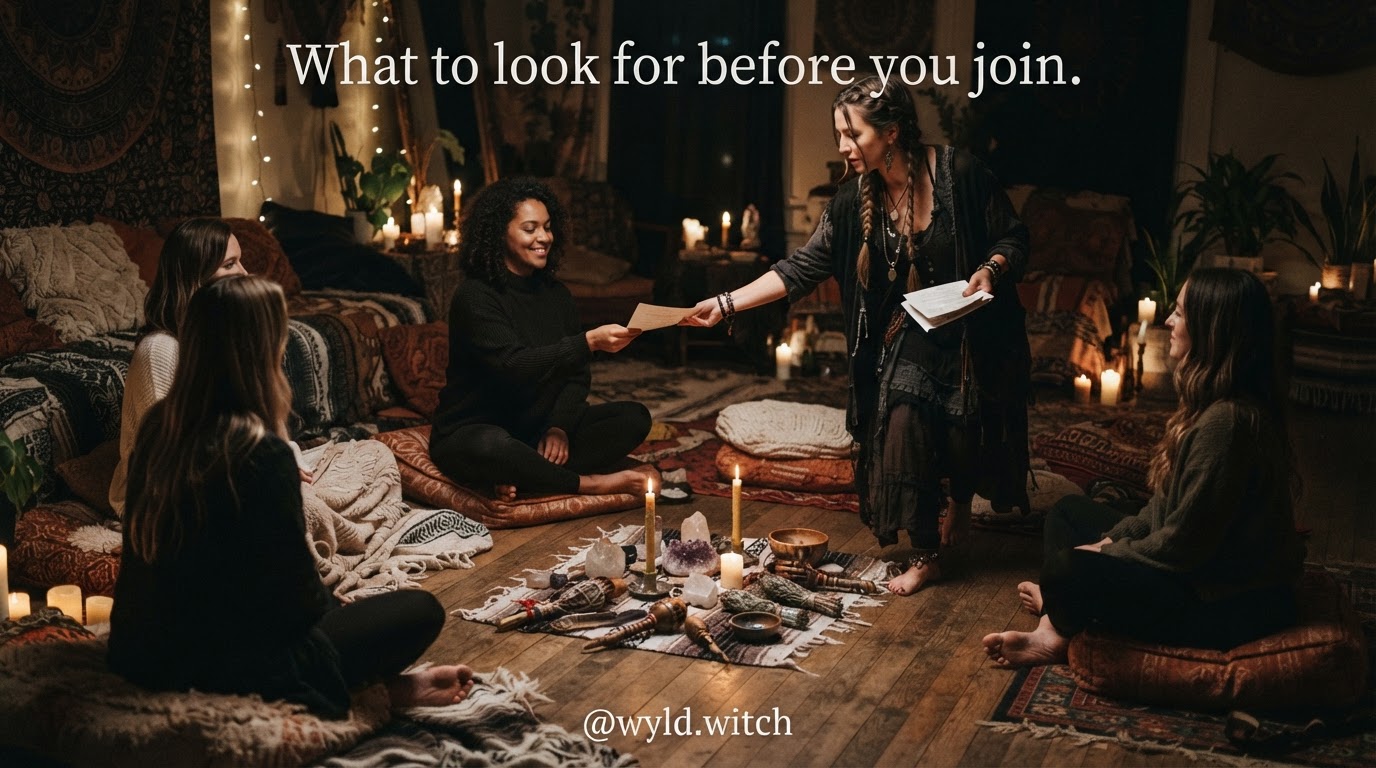
If You’re Looking for a Group to Join
If this is calling to you and you’re thinking about stepping into a ceremony space for the first time, here’s what to actually look for — and look out for.
Ask about your facilitator’s training. Where did they learn this? How long have they been practicing? What experience do they actually have with it? These are completely fair questions. If a facilitator gets defensive or offended by them, that’s your cue to walk away — there’s too much ego in the room for that to be a safe container. Watch for answers like “I did a one or two week training” with nothing behind it since. That’s very different from someone who trained briefly years ago and has spent a decade in practice and mentorship under other facilitators since.
Make sure sacred space is actually being called in. A real ceremony opens the space intentionally before anything else happens — and closes it just as intentionally at the end. This matters more than people realize. When you open up in ceremony, it’s not just your heart and body that open — your spirit opens too. You want to be in a protected space before you step into that kind of vulnerability together, not just sitting in a room that happens to have some candles in it.
Check the physical setup ahead of time. Is it a floor ceremony? Will there be floor chairs or cushions? If it’s going to run long, it might be worth bringing your own.
Drink water throughout, and especially after. Ceremony is generally dehydrating, so staying hydrated matters through the whole thing, not just at the end. If water isn’t provided where the ceremony is taking place, make sure you come prepared and bring your own.
Ask about confidentiality. Is there a clear agreement that what’s shared in the circle stays in the circle? That matters enormously when people are being vulnerable in front of near-strangers.
Wear something comfortable, and if you’re coming straight from work, give yourself ten or fifteen minutes first — sit in your car, mentally set down as much of the day as you can, and ground before you walk in. Showing up scattered and depleted doesn’t serve you or the circle.
Don’t stack ceremonies back to back. Even a ceremony that’s “just talking” is still a ceremony the moment sacred space is called in — there’s a real energetic shift and exchange happening, even if nothing dramatic seems to occur. If you learned something new, had a breakthrough, had a moment — your energy needs time to settle into that before you ask it to do the same thing again. A popular and healthy retreat format is ceremony, break, class, break, ceremony, break — never stacking ceremonies with no room to breathe in between. Give yourself at least a couple of hours between them, minimum.
Be cautious with plant medicine, especially as a beginner. If you’re new to this work, be wary of any facilitator who has you combining multiple strong plant medicines — ayahuasca, cacao, hapé, sananga — in your early ceremonies, before you’ve built any real relationship with each one individually. That’s different from an experienced practitioner with years of individual relationship to each medicine choosing to combine them thoughtfully. For someone just starting out, each of these is already its own complete ceremony. Be wary of anyone treating them otherwise.
And this one matters more than any of the others: watch for isolation and pressure. Be wary of a facilitator who discourages you from other teachers, other communities, or your relationships outside the group. Be wary of anyone who positions themselves — or the group — as the only place you’ll find real healing. Be wary of guilt, fear, or pressure around money, time, or loyalty used to keep you close. This often starts small — the same defensiveness that shows up when you ask about training can be the first crack in a much bigger pattern. It can happen to anyone, including people who’ve been doing this work for a very long time. Trust that instinct if something feels off, even if you can’t name exactly why yet.
Coming Home to Each Other
Whatever draws you in — a monthly women’s circle, a drum circle, a men’s rites of passage weekend, a sound bath with strangers who feel like family by the end — the craving underneath it is the same. We spent years learning how to be alone together on a screen. Ceremony is how we’re remembering how to be alone together in a room, and then not alone at all.