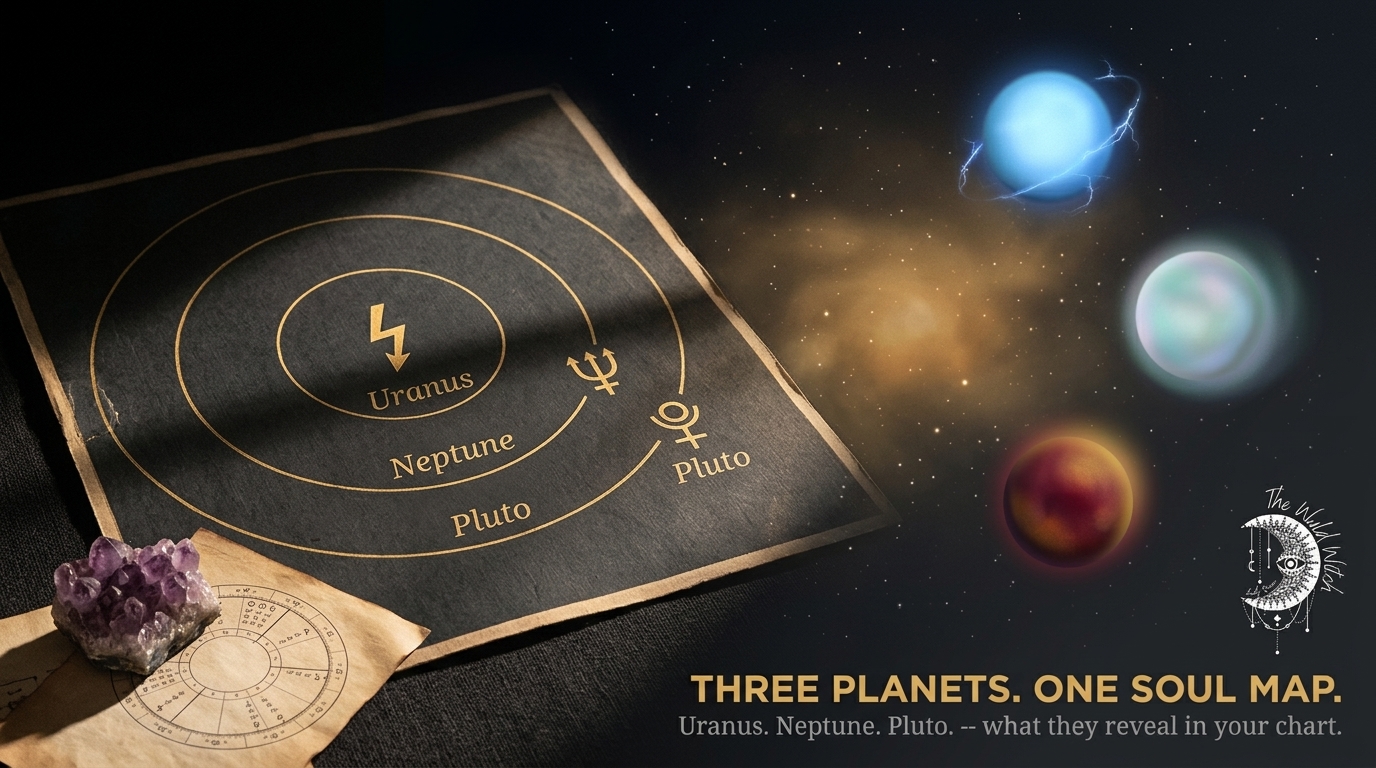

Most people think Uranus, Neptune, and Pluto are just the “weird outer planets” — the ones that move so slowly they barely seem personal at all. It’s more than that. In evolutionary astrology, these three aren’t background noise. They’re the planets that carry your soul’s oldest business: the freedom you’re here to claim, the surrender you’re here to learn, and the transformation you can’t outrun. Learn to read them, and your chart stops being a personality quiz and starts being a map of where your soul is actually headed this lifetime.
Let’s walk through each one. (If you want the full picture of how these three work together, Forrest’s own integrated view of Uranus, Neptune, and Pluto is worth the read.)
Uranus: The Awakener

Uranus doesn’t care about your five-year plan. In the evolutionary tradition, Uranus is the planet of the soul breaking its own contract with conformity — the part of you that has agreed, somewhere across many lifetimes, to stop shrinking to fit what’s expected. It doesn’t show up as random rebellion. It shows up as a pressure that builds until something has to give.
What Uranus Actually Means in Your Chart
Where Uranus sits in your chart marks the place your soul refuses to run on autopilot. This isn’t the planet of quirky hobbies — it’s the planet of genuine liberation, and liberation is rarely comfortable while it’s happening. Uranus will disrupt whatever it touches until you stop performing a version of yourself that was never really yours. Forrest Astrology’s own writing on Uranus goes deeper into this if you want more.
A Beginner Example: Uranus in the Sixth House
Say Uranus sits in the sixth house — the house of daily routine, work, and health. This isn’t a placement that wants a schedule handed down from someone else. The soul here has often spent other lifetimes boxed into rigid structure, and this time around, it’s done. A conventional nine-to-five might genuinely make this person sick, while an irregular schedule, a self-directed job, or an unconventional healing practice lets the nervous system finally exhale. The instability that looks like a flaw from the outside is often the exact condition the soul needs to keep evolving.
A quick note: if Uranus is retrograde in your own chart, that doesn’t mean you’re repeating this lesson. It means the timeline for this particular liberation has compressed — this lifetime is asking you to move through it faster, because there’s more waiting on the other side. Jodie Forrest has a good breakdown of retrogrades if you want to sit with this idea longer.
Neptune: The Mystic
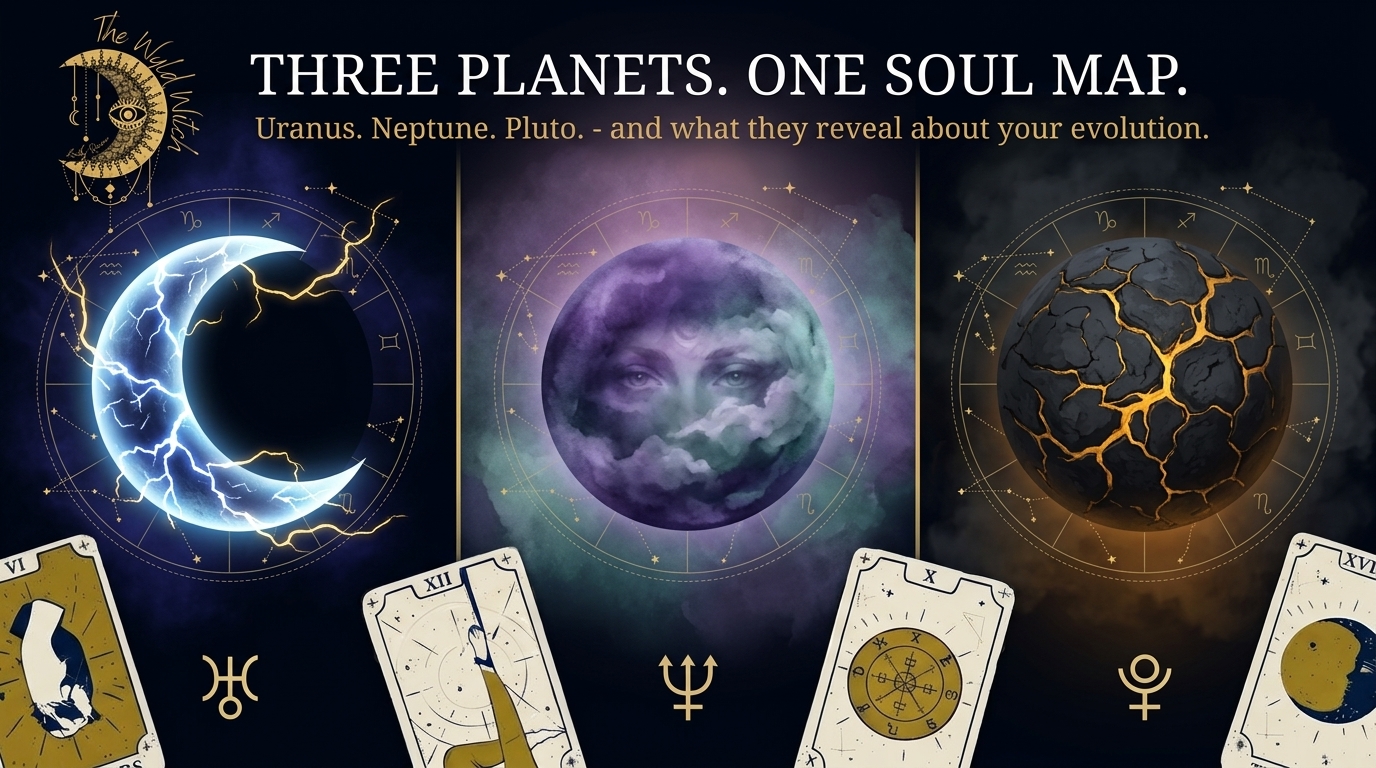
Neptune is where the boundary between you and something larger gets thin. It’s the most misread planet in the chart, mostly because people treat it as pure inspiration when it’s really asking for discernment. Neptune’s gift and Neptune’s confusion come from the same source: the willingness to dissolve.
What Neptune Actually Means in Your Chart
Neptune’s house shows where you’re most likely to touch the numinous — and also where you’re most likely to lose your footing in illusion, self-deception, or other people’s projections. Both are true at once. This isn’t a planet to romanticize without also naming its real cost when it isn’t handled with awareness. More of Forrest’s writing on Neptune lives here if you want to keep reading.
Where Your Soul’s Compassion Lives
The house Neptune occupies is usually where compassion, imagination, and intuition flow the most freely for you — and it’s also where you have to build the clearest boundaries, because that same openness makes you permeable to confusion if you’re not paying attention. Evolutionary astrology doesn’t ask you to armor up against Neptune. It asks you to stay conscious inside it.
A Beginner Example: Neptune in the Eleventh House
Neptune in the eleventh house — the house of friendship and community — often means this person sees their people through a haze of hope before they see them clearly. There’s a real spiritual gift here: a genuine intuitive read on group dynamics, a pull toward community built around something sacred rather than convenience.
The growth work is learning to trust that intuition about people without dressing every friend up in a role they never auditioned for. I encourage anyone with this placement to let their gut lead them toward the meditation circle, the volunteer crew, the found family — and to let that same gut tell them the truth when a connection isn’t what it looked like from a distance.
Pluto: The Phoenix
Pluto is the planet evolutionary astrology takes the most seriously, because Pluto is where your soul’s core intention for this lifetime actually lives. This isn’t the planet of random hardship. It’s the planet of the exact material your soul came back to finish.
What Pluto Actually Means in Your Chart
Wherever Pluto sits, that’s where you’ll be asked to die and come back changed — sometimes more than once. Steven Forrest’s tradition doesn’t treat this as punishment. No soul incarnates with nothing left to do, and Pluto marks precisely what’s left. The intensity isn’t a design flaw. It’s the point. Forrest wrote an entire book on this one planet — The Book of Pluto — for anyone who wants to go further than a beginner’s guide can take them.
Reading the Karmic Pattern
Through this lens, Pluto’s house reveals karmic material — patterns carried in from before this life that are asking to be met consciously instead of repeated unconsciously. Confront what Pluto is pointing at directly, and it stops running your life from the shadows and starts becoming the thing you’re genuinely strong in. A wound worked all the way through doesn’t just heal — it turns into a map you can hand to someone still living inside the version of it you already survived.
A Beginner Example: Pluto in the Fourth House
Pluto in the fourth house lands squarely in home, family, and ancestry. There’s often a pull toward whatever the family has agreed not to talk about — old grief, old secrets, inherited patterns that skipped a generation’s awareness but never actually left. This placement doesn’t want you to inherit the silence. It wants you to break it, gently or otherwise, and in doing so free up something that’s been stuck in the family line for a long time. That’s not a comfortable process. It’s usually a healing one.
🌌🔮✨
Frequently Asked Questions
What does Uranus mean in an evolutionary birth chart?
Uranus marks where your soul is done conforming. Its house shows the area of life where you’re being pushed to stop performing what’s expected and start living from what’s actually true for you — even when that disrupts the people around you.
How does Neptune relate to my soul’s purpose?
Neptune shows where you’re naturally porous to something bigger than the everyday — intuition, compassion, creative or spiritual insight. It’s a genuine gift, and it comes paired with a real need for discernment, since the same openness that lets in inspiration can also let in illusion if you’re not paying attention.
Why does Pluto get connected to past lives?
Pluto marks the material your soul is still actively working through — patterns intense enough that they carried forward instead of resolving. Evolutionary astrology reads this house as unfinished business your soul chose to come back and meet, not as a curse.
Want to go deeper into evolutionary astrology at the source? Steven Forrest’s Forrest Astrology lays out the tradition this entire approach is built on, and The Inner Sky is the book I’d point any beginner toward first.